


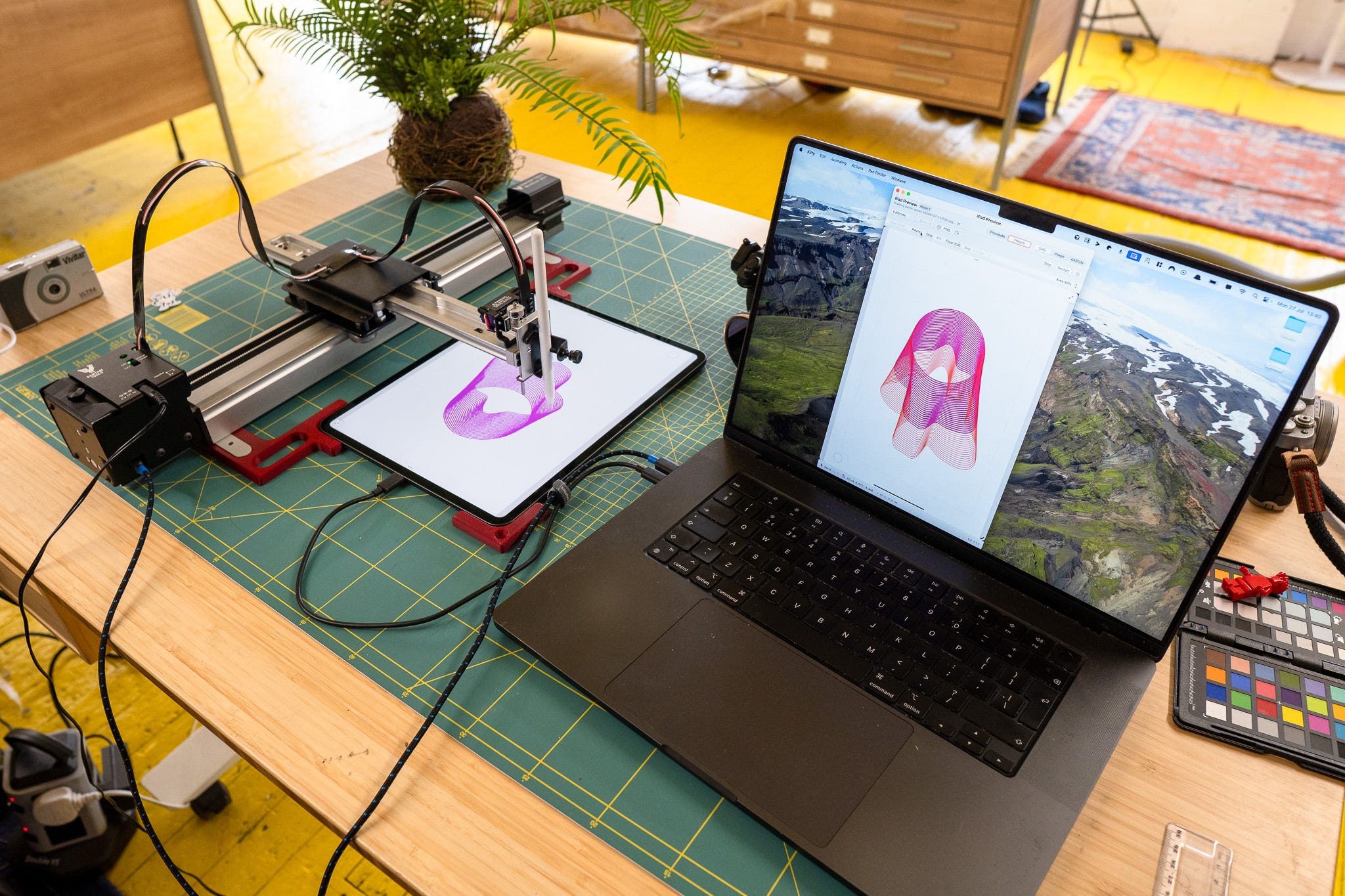
Last newsletter we’d just gotten the drawing machine/iPad thing going, here’s the whole laptop-iPad-drawing-machine setup. The laptop is getting a live feed of the iPad screen & overlaying a preview of the SVG that it’s currently sending to the machine.
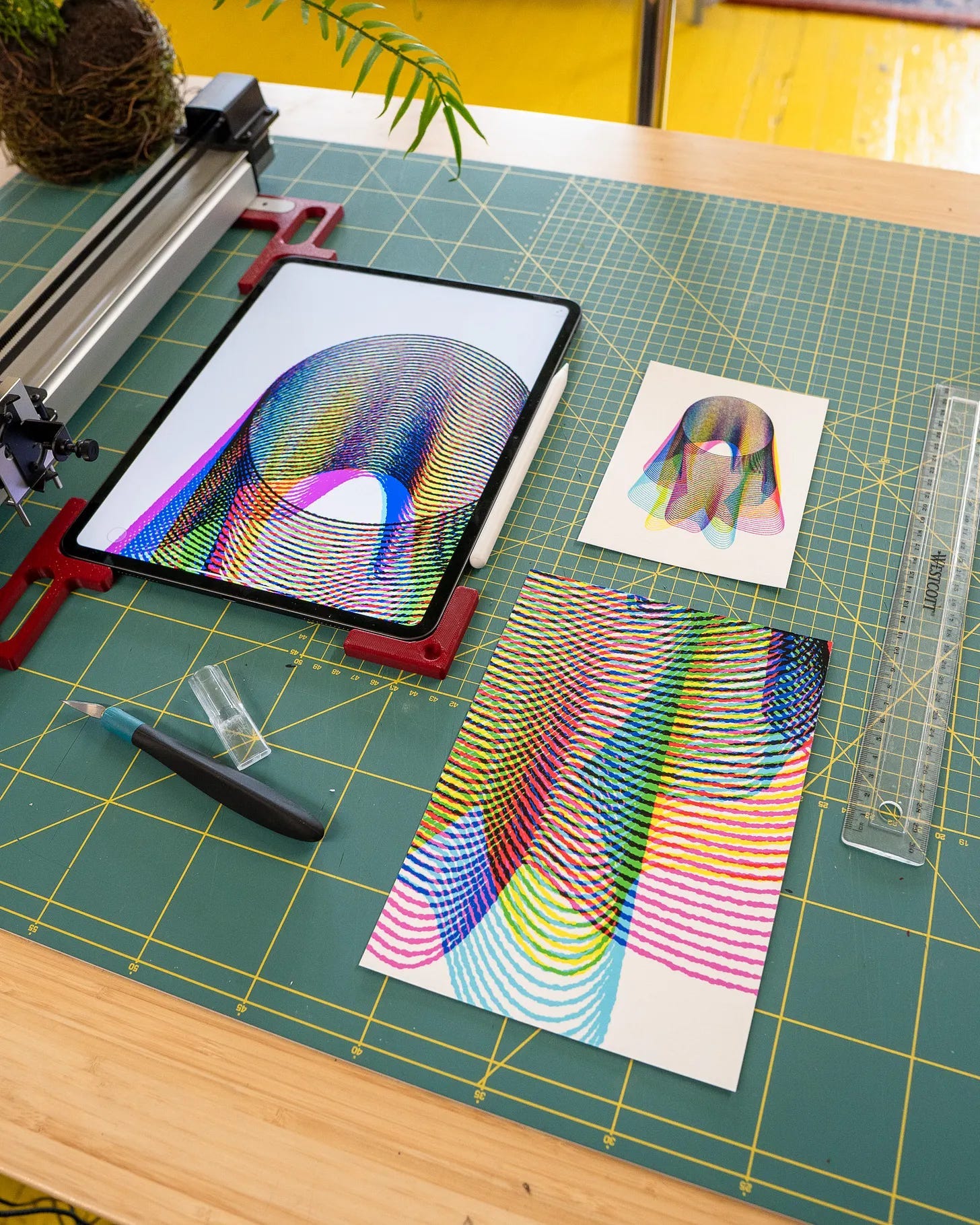
The end result was a CYM(k) “plot”, which I then printed and also printed a zoomed in version.
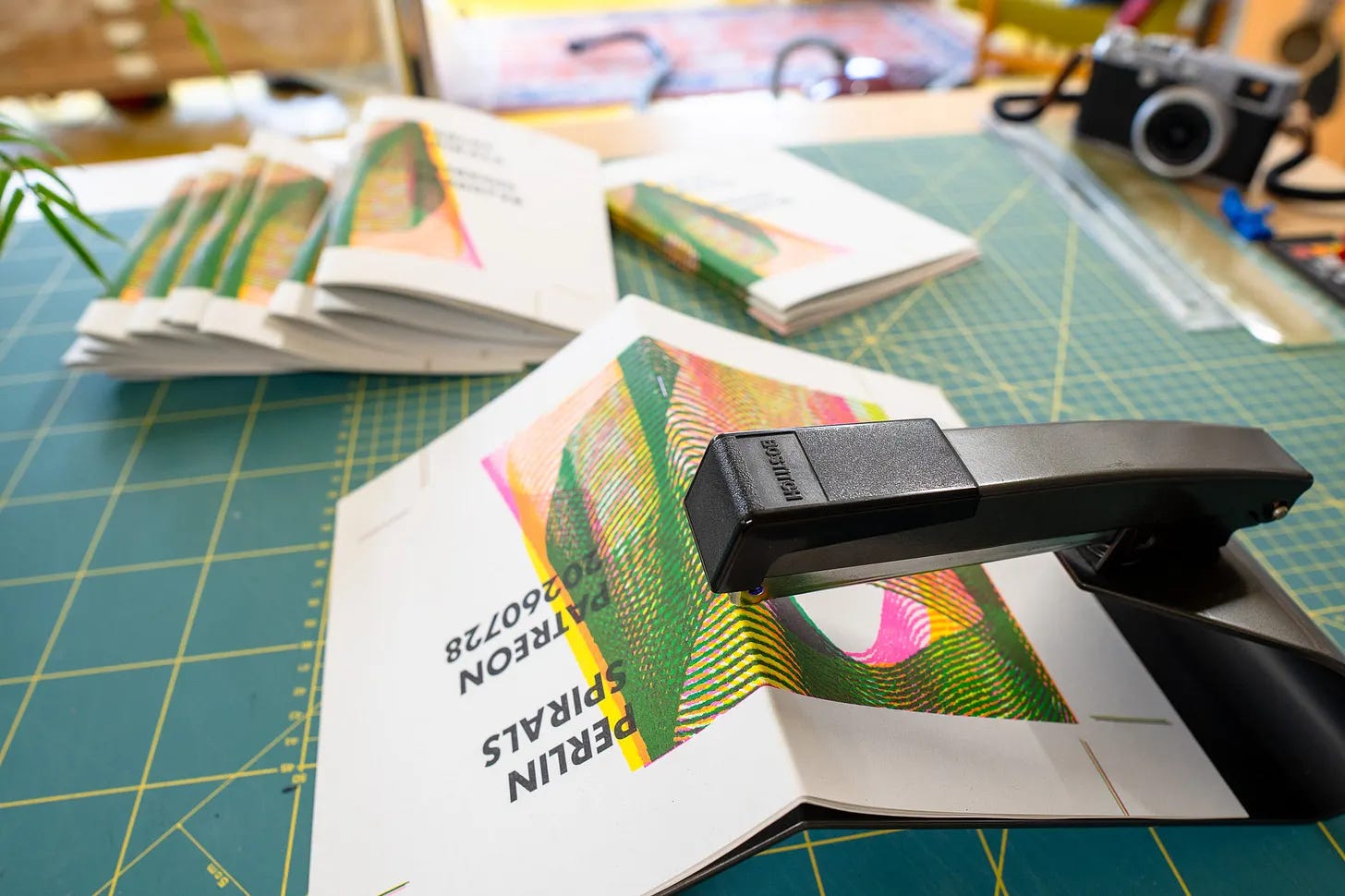
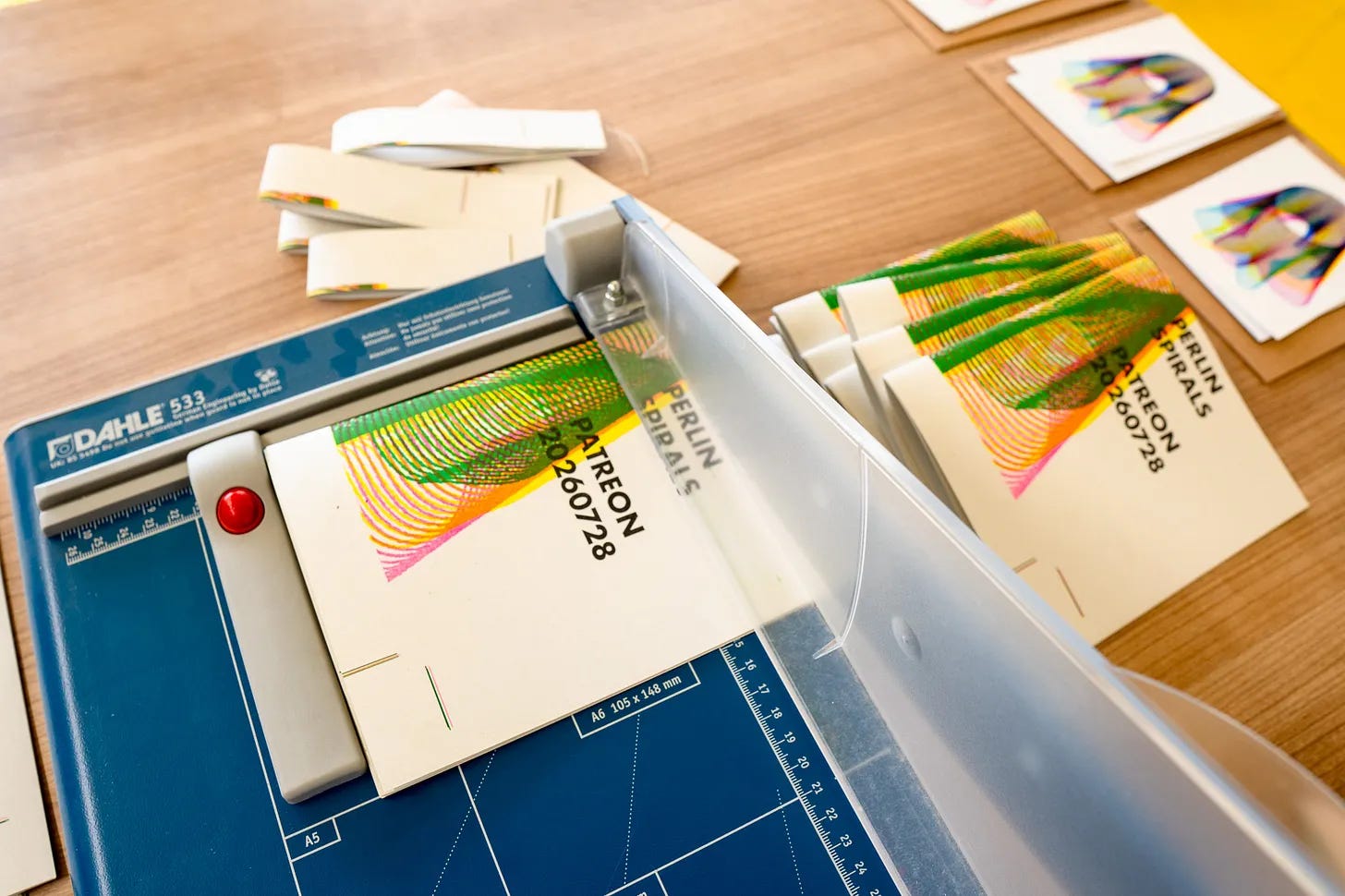
And the whole thing ended up printed in a zine, that went off to the Patreon peeps.
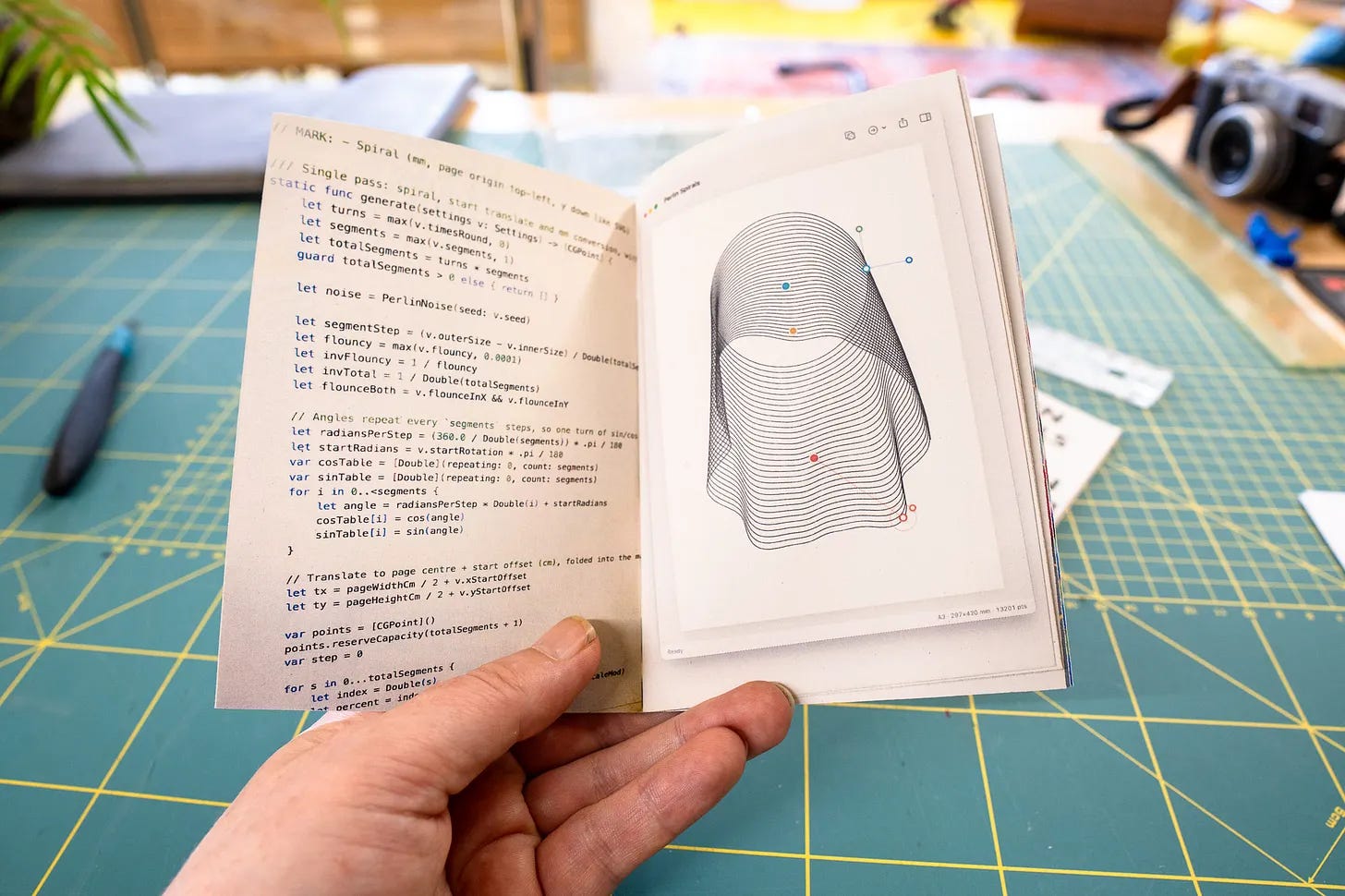
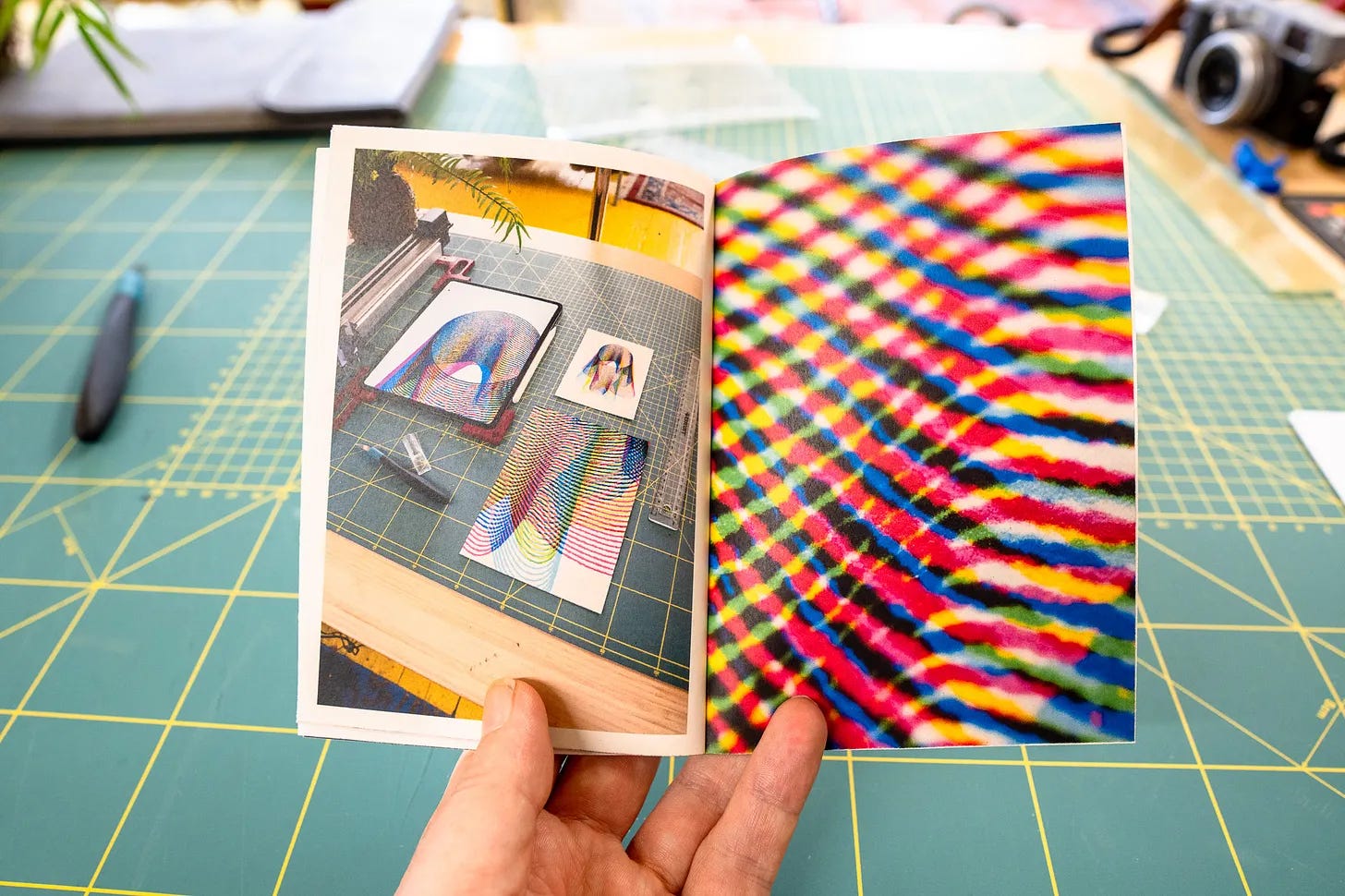
Some zine process photos.
# PROCESS ARTIFACTS
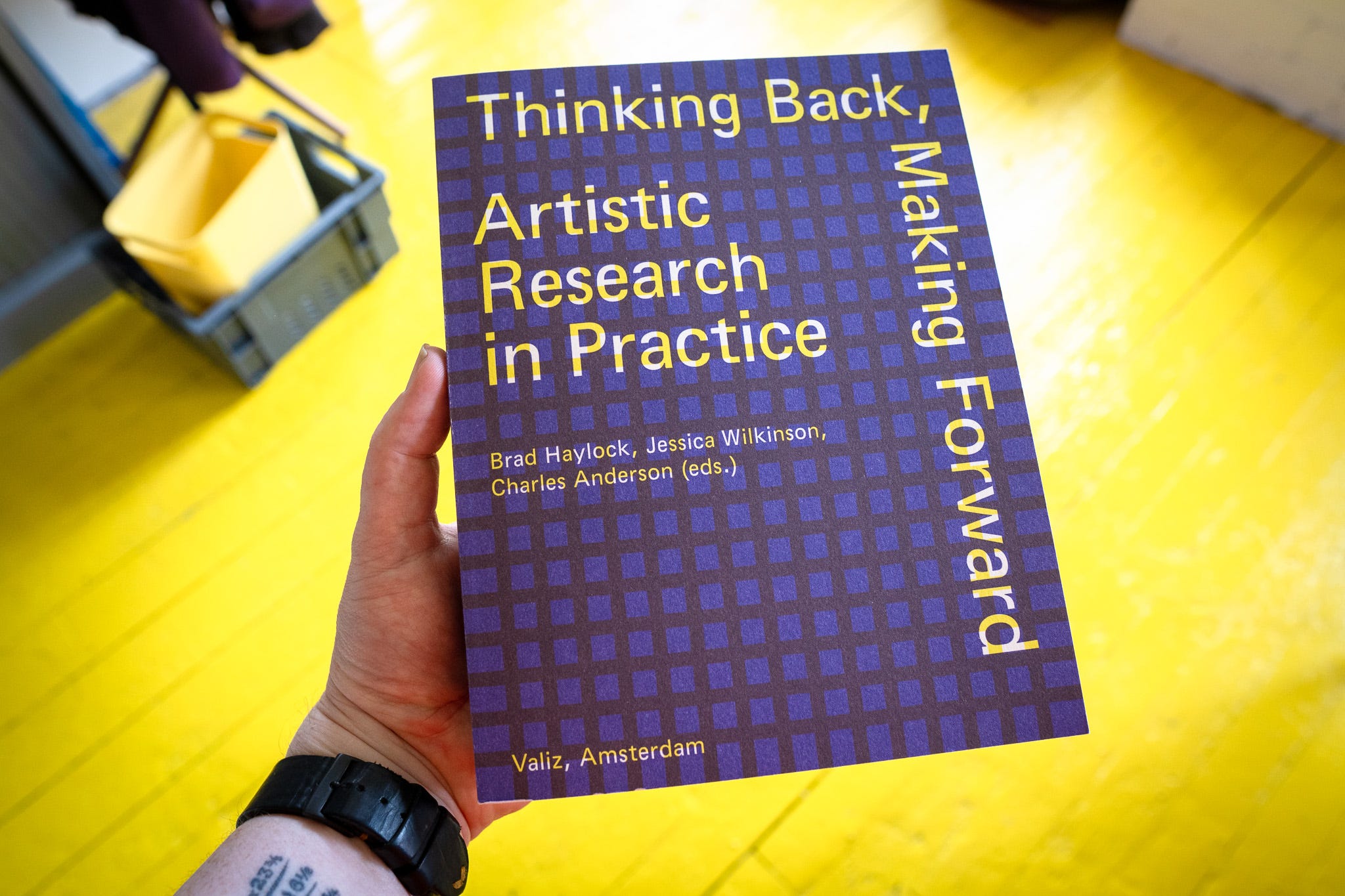
This rather wonderful book landed on my desk from Perimeter Books - although, if you’re in Europe I’d suggested buying it directly from Valiz, Amsterdam. From the blurb…
For this book we issued an open call to ask artists how PhD research has influenced their making and thinking. Our questions were: What are the impacts, urgency, and significance of the PhD for creative practitioners? How are these understood, captured, communicated? How did it change your practice? We even asked: should creative practitioners undertake a PhD in the first place?
I’m about a third of the way through - which is easy to know as there’s about 30 essays in here, and I’ve read around 10 - it’s not the easiest read (to me) ‘cause by it’s very nature the language can be fairly academic. Several times I had to go back and re-read something because while I’d taken all the words in, they didn’t actually register and my brain hadn’t stuck them together in to a coherent whole.
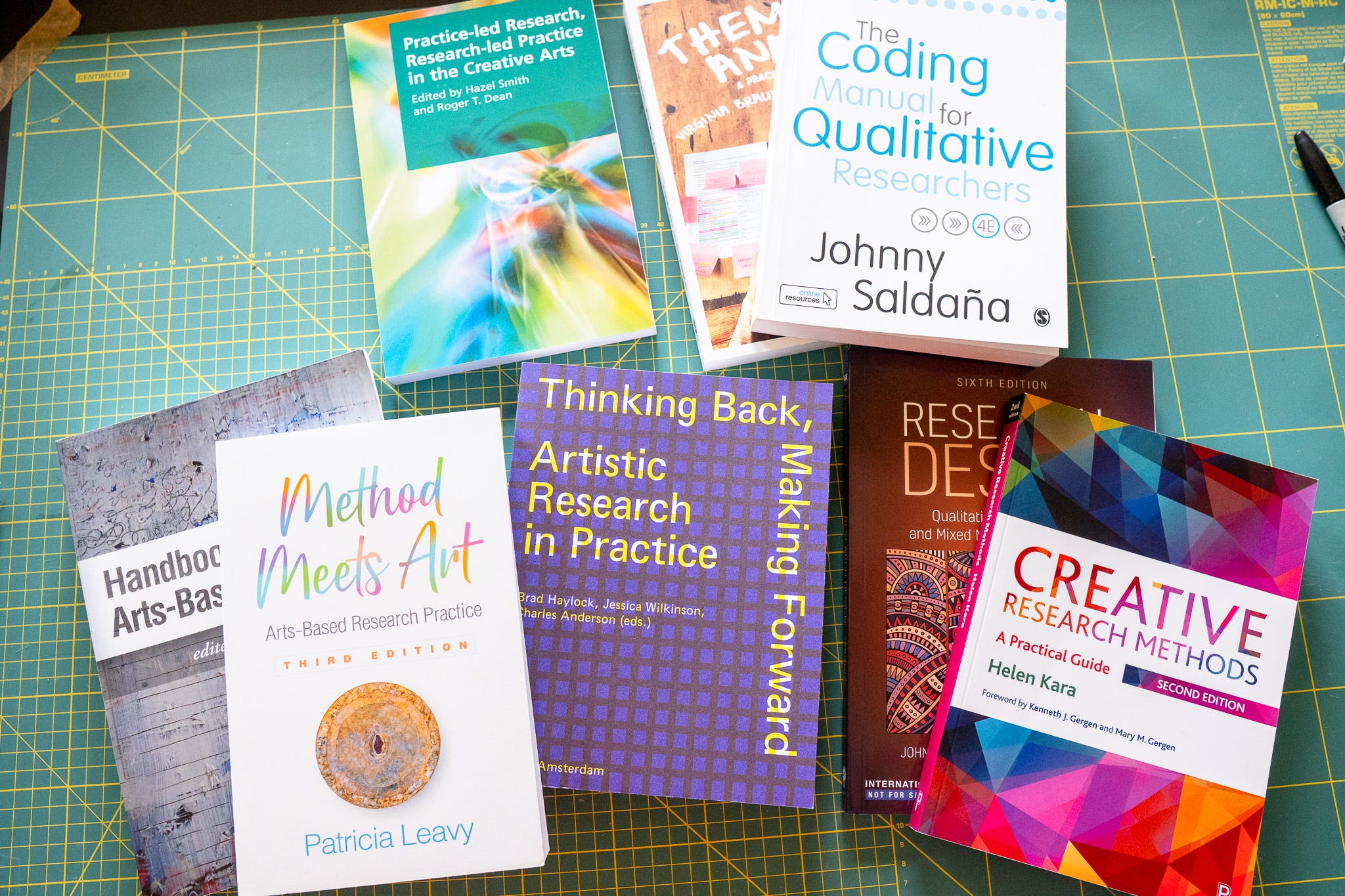
All that said, I continue to be fascinated by the whole process; the act of art and creativity as research. Although it still feels like a field that’s finding it’s feet as people develop shared lexicon of ‘what should this whole thing be called’ - and people arguing where the edges are, and even if it should be a thing at all.
What I can tell you from reading most of the below, is there isn’t a simple “This is how you do arts/practice based research”, which is of course, annoying.
My main take-away though, is often the process is more interesting than the final result. The things we learn while trying to get to the end result are more useful than the end result itself, as are the debug views into our code and process.
And!!
Unless you’re putting on exhibitions which show off all your sketchbooks and a screen-printed wall of text explains what it’s all about, what we often show off as a couple of photos on Instagram or our Website, is just the end result.
It only took a couple of essays to remind me to PRINT MORE SHIT OUT.
Taking photos is fine, making videos is cool, but, but, but, there’s nothing quite like printing a photo zine of 10 or so process photos, and then just having it.
I’ve made a promise to myself to make more zines, 10 photos and a cover is easy, each “project” no matter how small should end up with either a zine, and “photo book” (in the very loosest of terms), or some postcards.
Because - and I say this with love - it doesn’t need to be complicated.
# QUICK THOUGHTS ON AI (again)
I’ve seen a trend…
Actually, let me rephrase that.
I clicked a thing in Instagram, or, I hovered too long over a Reel and now I’m seeing a lot of these, which follow the same pattern.
Designer sits at desk, points at the screen, there’s an image on the screen being transformed into ASCII type, or colourful blocks, or something.
There’s fucking shit loads of sliders on a panel to the right or left, or both sides of the UI, there’s so many, they scroll, hell, maybe even throw some buttons at the top or bottom too, why not.
‘Comment “TOOL” in the comments, and I’ll DM you a link’ the designer says.
The tool probably looks something like this.
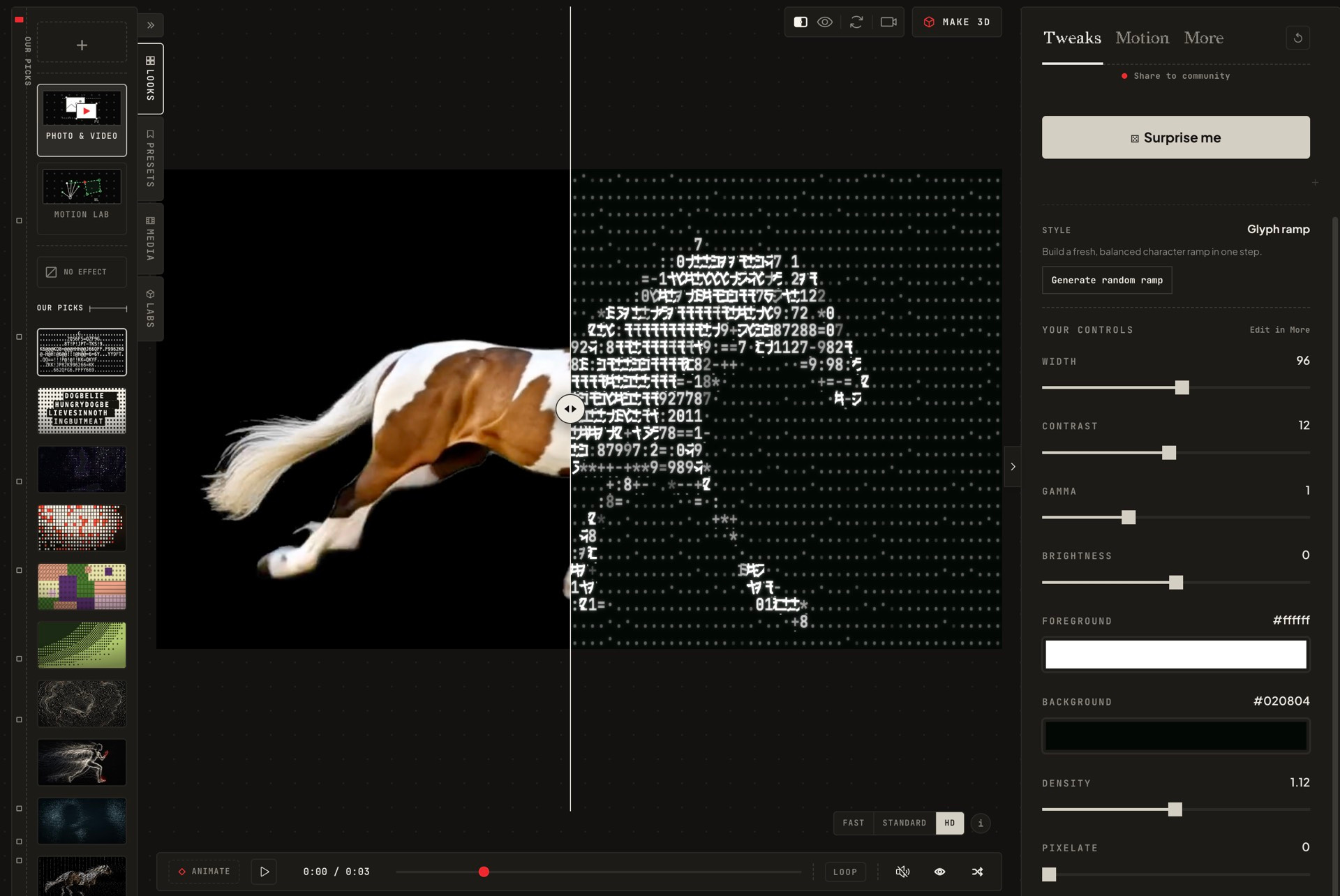
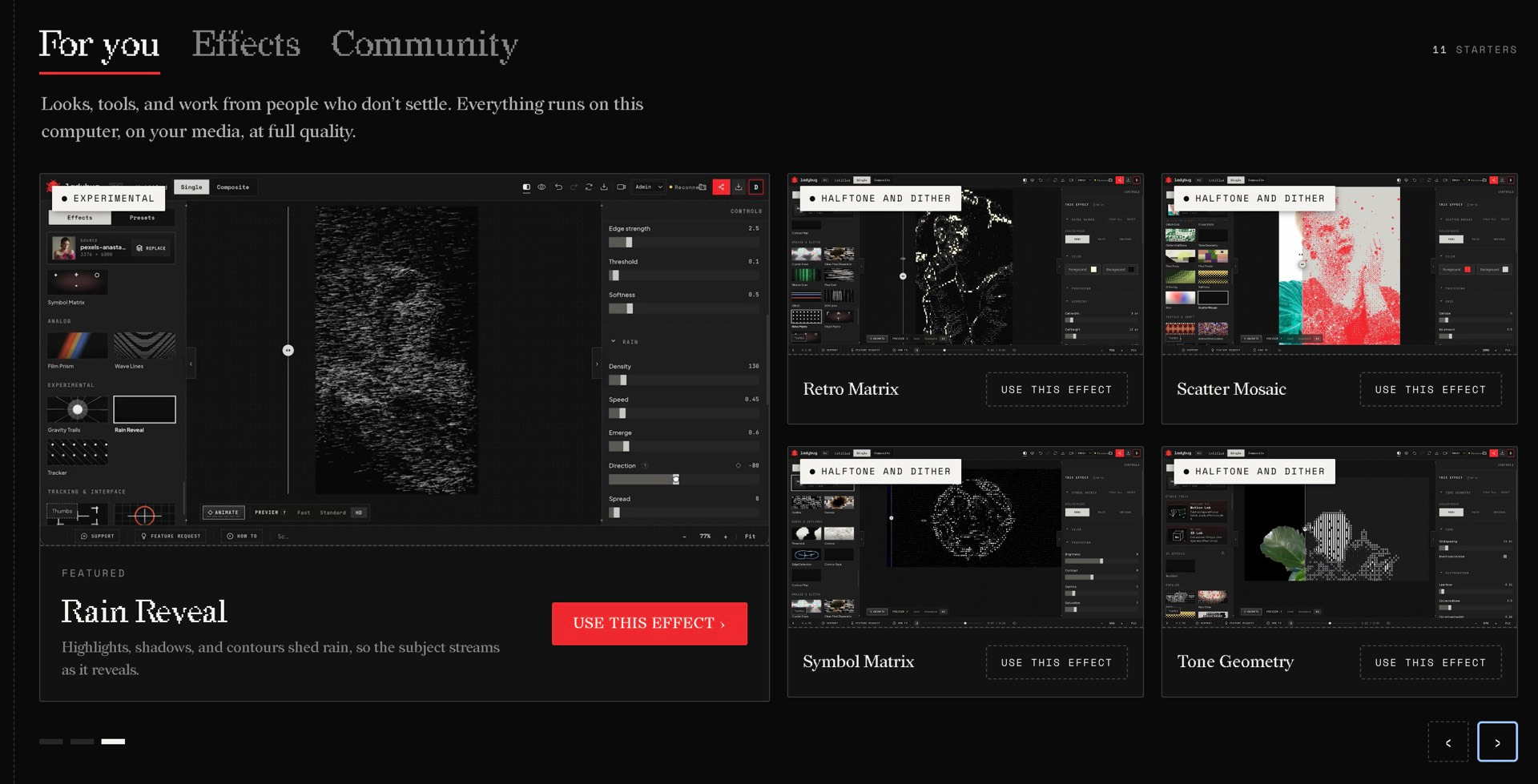
It’s clearly and obviously been written with, or by, AI.
I’m fairly ambivalent about this; if you need an end result, and a tool can get you to that end result, then I’m not sure it makes a huge difference if that tool is written by a human or an AI (based on lots of work created by humans).
The end result will be pretty, meh, in most cases, because the AI tool is shallow, even with all the endless sliders - there’s not much vision.
BUT, when I see these tools, I’m all…
‘why would I use your tool? You’ve just created it with AI, I can literally just say to AI, ‘make me a tool that turns an image into ascii’ and have my own version. If the effort is essentially zero, I can just do it myself’
And then the AI will go off and rip off all the code done by humans who put the effort into working out how to turn images into ASCII text, and build a near identical tool.
What’s the point of making tools, pointing at them and going “I made this amazing thing” - when anyone can just make it?
Well, I had to put those assumptions and bias to one side because hundreds if not sometimes thousands of people were commenting “TOOL” and “OMG I need this tool”, and “That’s amazing, so cool”.
‘cause it turns out, that if I step outside my bubble of understanding both code and AI - that apparently it’s not “easy to just do it in AI”, because people would rather write “TOOL” in a comment and use something '“written” by someone else prompting an AI, than do it themselves.
There is still a knowledge and skill gap.
The lesson I should probably learn is to throw away any scruples I have, churn out a bazzillion “tools” with AI while that skill gap still exists, and farm engagement by forcing people to jump through hoops to get access to the thing I “made”, rather than just provide a link, because, ugh, late stage capitalism - probably.
No, my main take away is wanting to remove all the sliders and controls and knobs and inputs and so on, on the tools I actually wrote years ago, and come up with clean, simple and elegant UIs for interaction, because the part that seems to be missing is asking the question “how would a sane human want to interact with this calmly?”
Here’s another take on AI from Patt, I’ve linked directly to the “My thoughts of AI” section, but why not watch the whole thing, 11m 10s.
# THE END
Last Friday was the last day of a five month contract [Hey, if you have some interesting new work, hit me up], and the last two to three weeks were pretty intense, so this week I was looking forwards to getting back to doing my own stuff.
I forgot about the whole decompression period, the weird lull after finishing a large job and odd emptiness. Each morning this week in my own ‘make and do art’ hours of the day I just couldn’t focus, the best I could manage was tidying up the studio getting it back to ship-shape condition, which is something I guess.
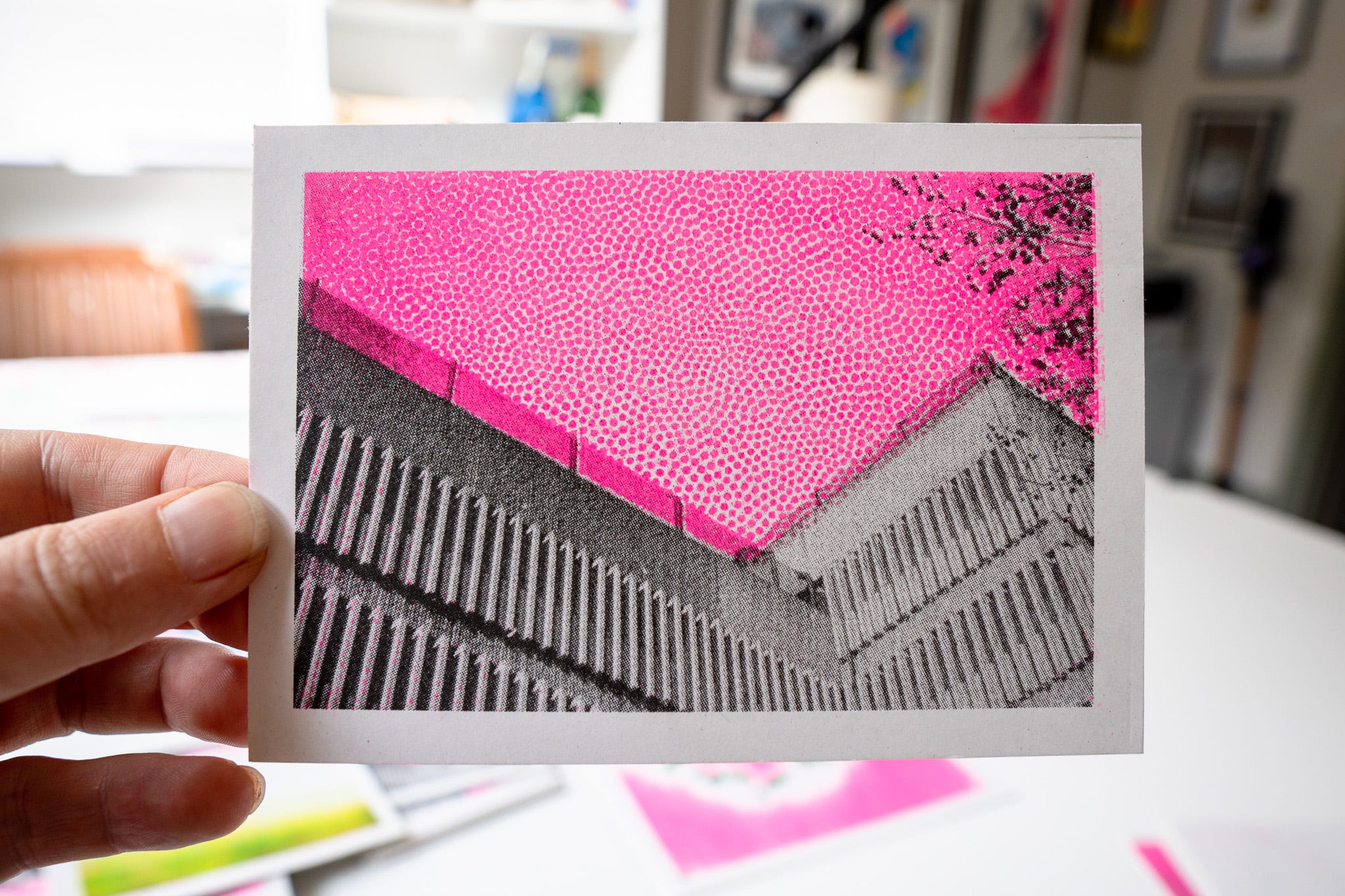
By today (Thursday) I’d abandoned all my plans, printed some riso experiments, and will try again next week. Including, the next few videos in the pen plotting YouTube series. Top priority, getting those back on track.
Let me know what tricks you have for getting back into action after finishing a job, and I’ll catch you back here on Thursday 20th August!
Love you all
Dan
🧡
Super cool and inspiring work. Definitely will subscribe and look forward to reading more!
Based on your ante-penultimate and penultimate paragraphs seems like the plan for getting back into action after finishing a job is "abandon all your plans and see what happens for a bit (and also allow yourself some gentle tidying up time as that's appealing without being capital D doing; and remember you'll probably need at least a week or two of this)".